Live Commerce Is Harder Than Expected
5 Things Brands Get Wrong When They Try to Run Live Commerce Themselves

Live commerce looks deceptively simple from the outside. Someone goes live on Whatnot or TikTok, holds up a jacket, people bid, it sells. How hard could it be?Pretty hard, it turns out. Brands that attempt live commerce independently run into the same walls over and over again, and the mistakes are costly, both in lost revenue and in brand perception. Here are the five most common ones.
And for every brand in that room watching it happen with their own eyes, the conversation about what to do with damaged and unsellable inventory will never be the same.
1. They treat it like a one-time event instead of a channel.
The biggest misconception brands bring to live commerce is that it works like a sample sale: set a date, go live, clear the inventory, done. That is not how this channel works. Live commerce audiences are built over time through consistency. The data is clear on this: as show frequency increases, GMV per show increases.
Revive's shows for Farm Rio started at $5,695 GMV per show in November 2025 and grew to $16,383 per show by February 2026, not because the inventory got better, but because the audience grew. By that February, over 35% of buyers were repeat purchasers, which is 2.5 times the average ecommerce repeat rate.Brands that go live once, or once a month, never build that compounding effect. The repeat buyer base is the whole engine. Without consistency, you are just running a very complicated one-off sale.
Revive's shows for Farm Rio started at $5,695 GMV per show in November 2025 and grew to $16,383 per show by February 2026, not because the inventory got better, but because the audience grew. By that February, over 35% of buyers were repeat purchasers, which is 2.5 times the average ecommerce repeat rate.Brands that go live once, or once a month, never build that compounding effect. The repeat buyer base is the whole engine. Without consistency, you are just running a very complicated one-off sale.
2. They underestimate what a host actually does.
A live commerce host is not an MC reading off a product description. They are simultaneously a stylist, an auctioneer, a brand representative, a customer service rep, and an entertainer, all at once, in real time, with no ability to pause or edit.Getting this wrong is not just a missed sales opportunity. It is a brand risk. A host who talks about your products as damaged goods, who does not understand the brand aesthetic, or who cannot explain why a $278 jacket is worth bidding on, does active reputational damage. The wrong energy on camera positions your brand as a clearance operation rather than a desirable label.
Revive maintains a network of hosts with different personas and skill sets, selects them based on alignment with each brand's ethos, and trains them on MSRP, product details, and styling before they go anywhere near a show. That preparation is not optional. It is the difference between a host who builds desire and one who erodes it.
Revive maintains a network of hosts with different personas and skill sets, selects them based on alignment with each brand's ethos, and trains them on MSRP, product details, and styling before they go anywhere near a show. That preparation is not optional. It is the difference between a host who builds desire and one who erodes it.
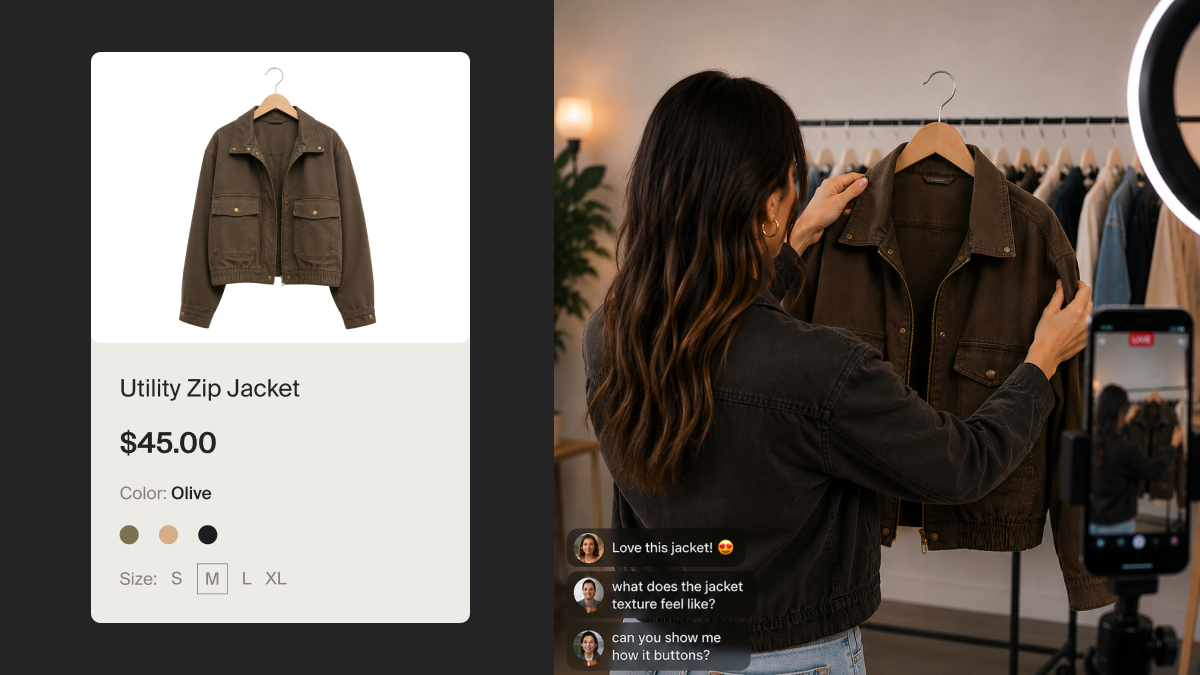
3. They set prices instead of using auction mechanics.
When brands try to run live commerce independently, they often approach it like a markdown event: here is the item, here is the price, buy it. This leaves significant money on the table.Auction mechanics work differently. Prices are never set in advance and never published. Items start low to generate competitive bidding, and when multiple buyers want the same piece simultaneously, urgency drives the final price up.
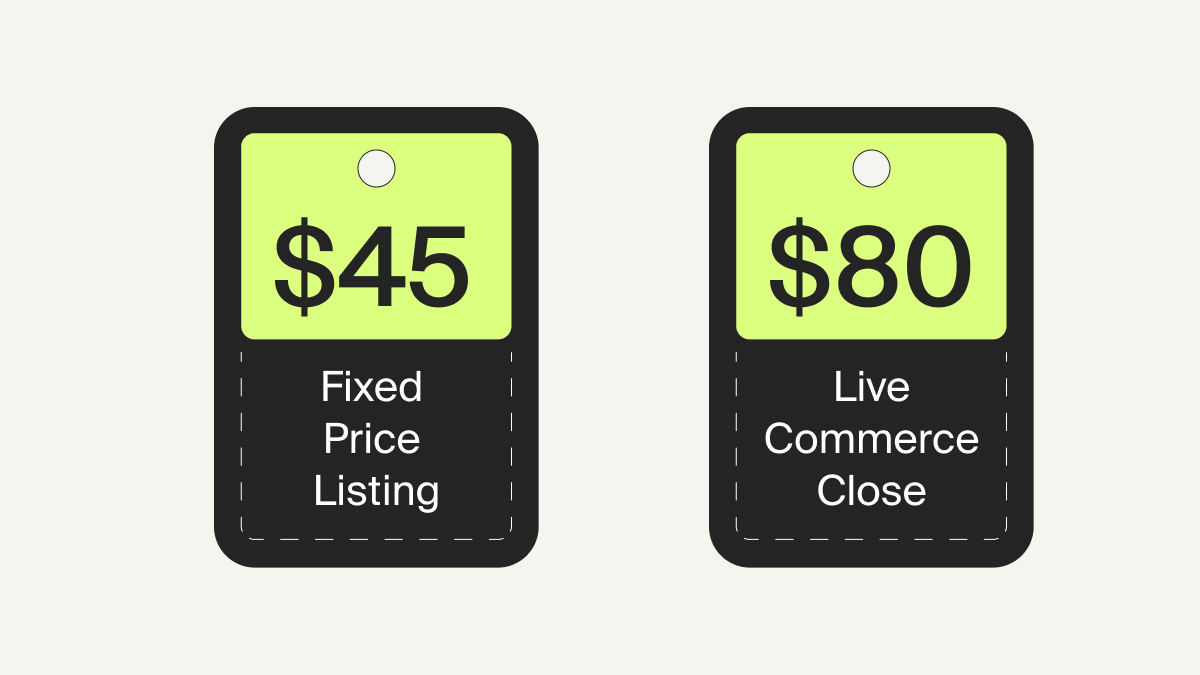
A piece that might sit at $45 as a fixed-price listing can close at $80 or more when three people are actively competing for it.Beyond the per-unit economics, fixed pricing creates a permanent public record. A screenshot of your $278 jacket selling for $40 can circulate indefinitely and recalibrate what customers think your product is worth. Gated, auction-based live shows leave no such trace. The price existed in a live moment, and then it was gone.
A piece that might sit at $45 as a fixed-price listing can close at $80 or more when three people are actively competing for it.Beyond the per-unit economics, fixed pricing creates a permanent public record. A screenshot of your $278 jacket selling for $40 can circulate indefinitely and recalibrate what customers think your product is worth. Gated, auction-based live shows leave no such trace. The price existed in a live moment, and then it was gone.
4. They do not know how to build or curate a show.
Knowing what to sell on a given night requires expertise that most brand teams do not have and have no reason to have developed. Which items go first to build momentum? How do you balance sizing breadth so buyers do not tune out because nothing fits them? When do you use extended bidding versus a quick close? How do you read the chat in real time and adjust pacing accordingly?
These are not instincts. They are skills. Revive's team brings over six years of live commerce experience across multiple platforms, with backgrounds in merchandising, show production, and audience building. They pre-load inventory before each show to encourage pre-bids and drive excitement before the camera ever turns on. They sequence each show to account for seasonality and category mix. None of that happens by accident or on a brand's first attempt.
These are not instincts. They are skills. Revive's team brings over six years of live commerce experience across multiple platforms, with backgrounds in merchandising, show production, and audience building. They pre-load inventory before each show to encourage pre-bids and drive excitement before the camera ever turns on. They sequence each show to account for seasonality and category mix. None of that happens by accident or on a brand's first attempt.
5. They forget about everything that happens after the show ends.
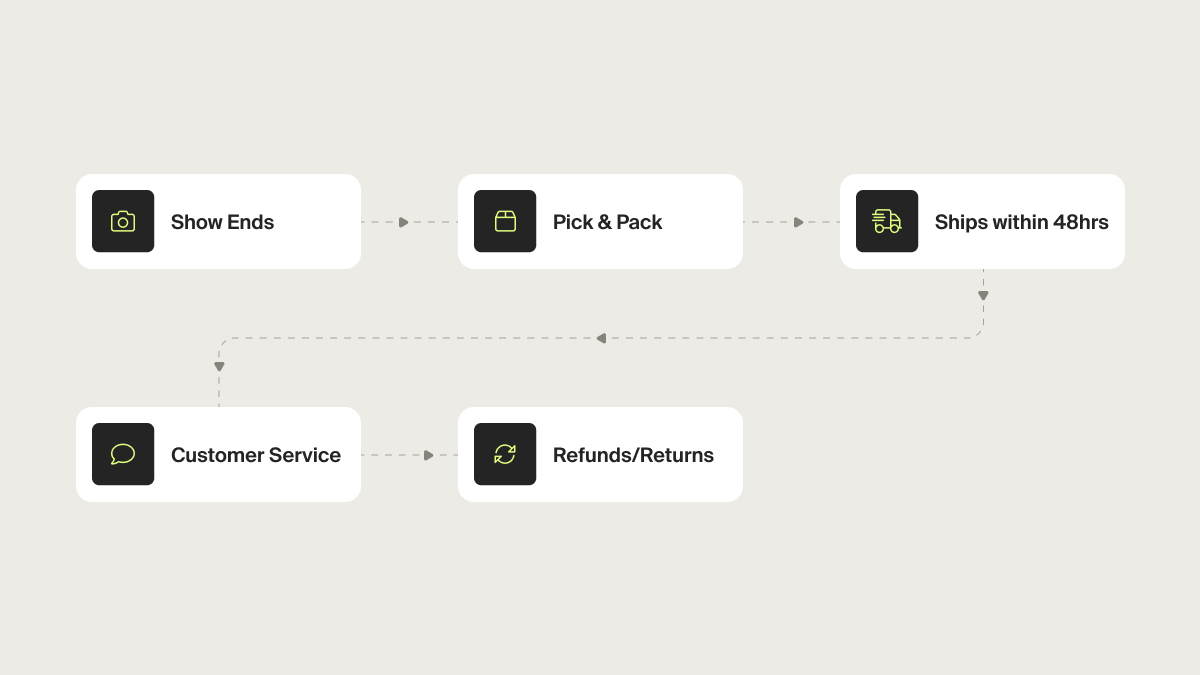
Live commerce is not just a sales channel. It is a fulfillment operation. Every item that sells needs to be picked, packed, and shipped, typically within a two-day window. Returns need to be handled. Customer questions need to be answered. Refunds need to be processed.
For brands running their own shows, this operational tail is often completely underestimated. Internal teams are not built for single-SKU ecommerce fulfillment at volume. The infrastructure that makes live commerce economically viable requires warehousing, conditioning, photography, listing optimization, and end-to-end customer service all running in parallel with the shows themselves.
Revive handles all of it -- three studios, three warehouses with dedicated QA, sorting, packing, and refurbishment teams, and a tech stack that intelligently routes each garment to its highest-value channel based on the brand's goals. From intake to first live show in two weeks. That kind of speed and infrastructure is not something a brand builds on its own without significant investment and lead time.
For brands running their own shows, this operational tail is often completely underestimated. Internal teams are not built for single-SKU ecommerce fulfillment at volume. The infrastructure that makes live commerce economically viable requires warehousing, conditioning, photography, listing optimization, and end-to-end customer service all running in parallel with the shows themselves.
Revive handles all of it -- three studios, three warehouses with dedicated QA, sorting, packing, and refurbishment teams, and a tech stack that intelligently routes each garment to its highest-value channel based on the brand's goals. From intake to first live show in two weeks. That kind of speed and infrastructure is not something a brand builds on its own without significant investment and lead time.
The Revive team at Sommwhere on Ludlow. April 22, 2026.
The bottom line
Live commerce is a genuinely powerful channel for clearing excess inventory at strong recovery rates. Farm Rio earned 150% more per unit through Revive's live shows than through their alternative channels, including 260 Sample Sale and TJ Maxx. But those results come from expertise, infrastructure, and consistency that take years to build.
The brands that try to stand up a live commerce operation in-house underestimate how many distinct disciplines need to come together for a show to perform well. The ones that partner with people who have already built it tend to get to results significantly faster, and without the brand risk that comes from learning on the job.
The brands that try to stand up a live commerce operation in-house underestimate how many distinct disciplines need to come together for a show to perform well. The ones that partner with people who have already built it tend to get to results significantly faster, and without the brand risk that comes from learning on the job.