The Brand Equity Question Every Premium Fashion Brand Is Asking
Live Commerce Won't Cheapen Your Brand. Here's Why.

Revive's live commerce studio featuring Farm Rio inventory at the Vogue Business x eBay Fashion Forum, May 2026
Every premium brand eventually faces the same uncomfortable math. Inventory piles up. Carrying costs run 20-30% of product value per year. The options on the table are inefficient: a sample sale that draws a crowd but trains customers to wait for discounts, a jobber who pays low only for items to end up in landfill or uncontrolled retail, or a static resale listing that puts your $278 jacket next to a screenshot of the $12 price tag on Google forever.
Live commerce is one of the fastest-growing retail channels in the world, projected to grow from $8.5 billion in 2025 to $69.3 billion by 2036. Fashion alone accounts for 27% of that market. But for premium and contemporary brands, the channel comes with a real concern that rarely gets addressed directly: what happens to your brand's reputation when someone is selling your products live, on camera, to thousands of people, at prices you didn't set?
It's a legitimate question. And the answer matters more than most brands realize when they first start exploring live commerce. The anxiety is also understandable. But it's also based on a false premise: that clearing excess inventory and protecting brand equity are in conflict. Done right, they aren't.
Live commerce is one of the fastest-growing retail channels in the world, projected to grow from $8.5 billion in 2025 to $69.3 billion by 2036. Fashion alone accounts for 27% of that market. But for premium and contemporary brands, the channel comes with a real concern that rarely gets addressed directly: what happens to your brand's reputation when someone is selling your products live, on camera, to thousands of people, at prices you didn't set?
It's a legitimate question. And the answer matters more than most brands realize when they first start exploring live commerce. The anxiety is also understandable. But it's also based on a false premise: that clearing excess inventory and protecting brand equity are in conflict. Done right, they aren't.
The real threat isn't clearance. It's visibility.
When a brand lists discounted inventory on a static resale platform, the price becomes a permanent public record. Customers find it through search. It gets compared directly to the brand's own site. A $40 sale price on a piece with a $200 MSRP doesn't just move inventory. It resets how customers think about what that item is worth, and by extension, what the brand is worth.
.png)
This is the problem that live commerce, structured correctly, actually solves.
Revive's shows are accessible only to registered platform members and are fully auction-based. Prices are never set in advance, never published, and never indexed. There is no static listing for a customer to screenshot, share, or stumble on three months later. The sale price exists in a live moment, in a competitive bidding environment, and then it's gone. What remains is a customer who won something they wanted, not a reference price that undermines full-price perception across every other channel.
Auction mechanics protect pricing integrity
Counter-intuitively, starting items at lower price points in a live auction format tends to produce higher final sale prices than fixed markdowns do. When multiple buyers compete in real time, urgency drives the price up. A piece that might sit at $45 as a static listing can clear at $80 or more when three people want it simultaneously. Pricing strategy is controlled by people who understand live commerce mechanics.
Farm Rio brought Revive 17,000 unsold items. Over four months of weekly live shows, average order value grew from $123 to over $140, and GMV per show grew from $5,695 to $16,383. That trajectory reflects something important: a live commerce audience builds. Repeat buyers return because the experience is competitive and engaging, not because the price is low.
Farm Rio brought Revive 17,000 unsold items. Over four months of weekly live shows, average order value grew from $123 to over $140, and GMV per show grew from $5,695 to $16,383. That trajectory reflects something important: a live commerce audience builds. Repeat buyers return because the experience is competitive and engaging, not because the price is low.
The host is a brand representative, not a liquidator
The other piece brands worry about is what actually gets said on camera. A host who talks about your products the wrong way, who positions them as damaged goods or end-of-season castoffs, does more reputational damage than any price point.
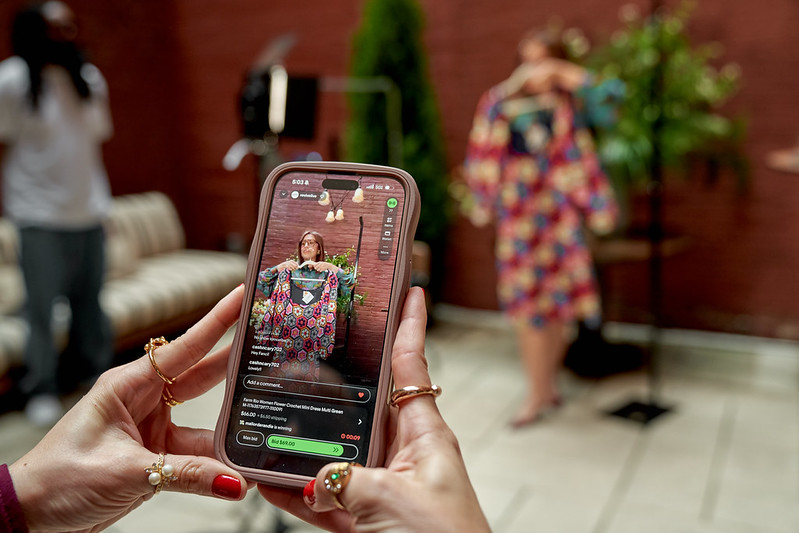
Revive matches hosts to brands based on alignment with brand ethos, then trains them on MSRP, product details, and styling before they go live. The show is moderated. The studio backdrop is designed to create a premium environment. The goal is a shopping experience that feels closer to a trunk show than a clearance rack.
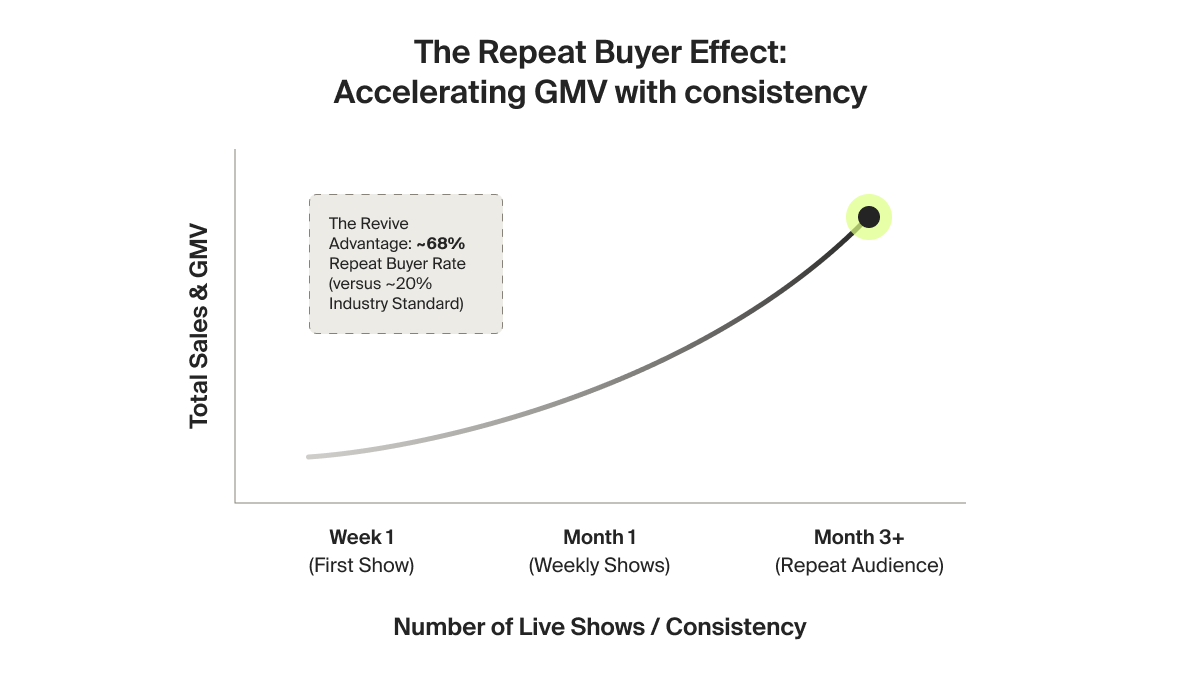
This matters for brand perception among the customers in the room, but it also matters for the repeat buyer dynamic. Revive's live commerce shows run a 50% repeat purchase rate, compared to roughly 20% for typical fashion ecommerce. Those returning customers are not returning because prices are cheap. They are returning because the experience is worth coming back for.
This matters for brand perception among the customers in the room, but it also matters for the repeat buyer dynamic. Revive's live commerce shows run a 50% repeat purchase rate, compared to roughly 20% for typical fashion ecommerce. Those returning customers are not returning because prices are cheap. They are returning because the experience is worth coming back for.
It’s not exactly easy to test on your own
Brands that attempt live commerce independently tend to underestimate two things: the operational lift and the expertise required to do it well.
The operational reality is significant. Live commerce isn't a social media post -- it's a production. Inventory needs to be catalogued, photographed, sequenced, and staged. Shows need to run consistently -- live audiences expect frequent, regular programming, and a brand that goes live once a month doesn't build the repeat buyer base that makes the channel valuable. For most brands, execution ends up sitting with the marketing or social team. It's neither sustainable nor scalable.
The expertise gap is equally real. Knowing which items to sequence first, how to pair pieces within a show, when to use extended bidding versus a quick close, how to read the chat and adjust in real time -- these are skills that take years to develop. Revive's team brings over six years of live commerce experience across platforms, with deep backgrounds in merchandising, show production, and audience building.
The operational reality is significant. Live commerce isn't a social media post -- it's a production. Inventory needs to be catalogued, photographed, sequenced, and staged. Shows need to run consistently -- live audiences expect frequent, regular programming, and a brand that goes live once a month doesn't build the repeat buyer base that makes the channel valuable. For most brands, execution ends up sitting with the marketing or social team. It's neither sustainable nor scalable.
The expertise gap is equally real. Knowing which items to sequence first, how to pair pieces within a show, when to use extended bidding versus a quick close, how to read the chat and adjust in real time -- these are skills that take years to develop. Revive's team brings over six years of live commerce experience across platforms, with deep backgrounds in merchandising, show production, and audience building.
The bottom line
Live commerce is a legitimate revenue channel for clearing excess inventory, recovering margin on end-of-season goods, and reaching new customers. The fashion industry generates an estimated $70 to $140 billion in excess inventory annually, and traditional clearance channels (sample sales, jobbers, off-price retail) recover a fraction of that value.
But the channel only works for premium brands if it's run with the same intentionality as any other customer touchpoint. That means trained hosts, controlled pricing mechanics, gated shows, and production values that reflect the brand rather than undercut it.
Live commerce done wrong is a liquidation event with an audience. Done right, it's one of the most effective tools a brand has for turning dead inventory into loyal customers.
But the channel only works for premium brands if it's run with the same intentionality as any other customer touchpoint. That means trained hosts, controlled pricing mechanics, gated shows, and production values that reflect the brand rather than undercut it.
Live commerce done wrong is a liquidation event with an audience. Done right, it's one of the most effective tools a brand has for turning dead inventory into loyal customers.
.png)
If you're sitting on unsellable inventory and wondering what brand-safe live commerce could do for it -- let's talk. hello@byrevive.com