Fashion's Next Big Sales Channel
What Is Live Commerce, and Why Are Fashion Brands Paying Attention?
Retail has been quietly transforming for the past few years, and a channel called live commerce is at the center of it. If you have not heard the term yet, you likely will soon. Fashion brands of all sizes are starting to take it seriously, and the numbers behind it make it easy to understand why.
So, What Actually Is Live Commerce?
Live commerce combines real-time video streaming with instant purchasing. Think of it as the modern evolution of the home shopping channel, but built for a generation that grew up on social media. A host goes live, showcases products, and viewers can ask questions, react, and buy in real time without ever leaving the stream.
What separates it from a standard product page or even a pre-recorded video is the live, interactive element. Shoppers can type questions directly to the host mid-show. They can get an honest answer about how a jacket fits, see the texture of a fabric up close, or watch how a dress moves on a real person. That immediacy and authenticity is hard to replicate through a static listing.
In fashion specifically, live commerce often leans into an auction or bidding format. Rather than a fixed price sitting on a product page, items go live one by one and shoppers bid in real time. One item typically goes live every 60 seconds. Prices are not published in advance. The result is a shopping experience driven by genuine excitement and market demand, where urgency is built into the format itself.
What separates it from a standard product page or even a pre-recorded video is the live, interactive element. Shoppers can type questions directly to the host mid-show. They can get an honest answer about how a jacket fits, see the texture of a fabric up close, or watch how a dress moves on a real person. That immediacy and authenticity is hard to replicate through a static listing.
In fashion specifically, live commerce often leans into an auction or bidding format. Rather than a fixed price sitting on a product page, items go live one by one and shoppers bid in real time. One item typically goes live every 60 seconds. Prices are not published in advance. The result is a shopping experience driven by genuine excitement and market demand, where urgency is built into the format itself.
The Platforms Making It Happen
The live commerce ecosystem has grown to include some serious players, and each brings a slightly different audience and format.
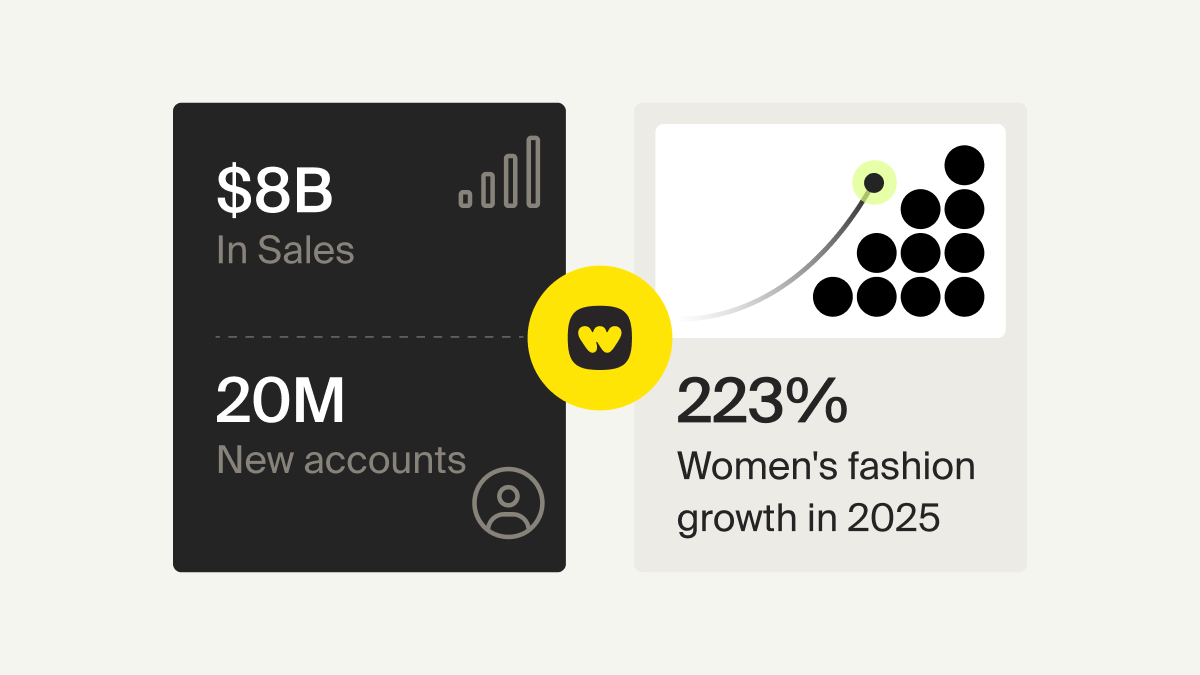
Whatnot is currently the number one live shopping platform in North America and Europe. It generated over $8 billion in live sales in 2025 and added more than 20 million new accounts in the same year. Fashion brands on Whatnot are moving 6,000 women's fashion items per hour, and top performers are generating $4,000 per hour per show. Women's fashion grew 223% on the platform in 2025 alone.
eBay Live brings the credibility of one of the world's most established marketplaces into the live format. For brands with existing brand equity or strong resale demand, eBay's live channel connects sellers to a massive buyer base that already understands how auctions work and comes ready to bid.
Posh Live, Poshmark's live selling feature, taps into a community that already skews toward fashion-forward, deal-savvy shoppers. The audience is pre-conditioned to discover and buy clothing through social interaction, which makes the leap to live selling a natural one.
TikTok has entered the space with live auction capabilities through TikTok Shop. Given that Gen Z consumers are already spending significant time on the platform and treating it as a discovery engine, live commerce there benefits from an audience that arrives looking to be entertained and inspired, not just to shop.Together, these platforms signal something important: live commerce is no longer a single platform experiment. It is a format that the major players in both social media and ecommerce are all betting on simultaneously.
Whatnot is currently the number one live shopping platform in North America and Europe. It generated over $8 billion in live sales in 2025 and added more than 20 million new accounts in the same year. Fashion brands on Whatnot are moving 6,000 women's fashion items per hour, and top performers are generating $4,000 per hour per show. Women's fashion grew 223% on the platform in 2025 alone.
eBay Live brings the credibility of one of the world's most established marketplaces into the live format. For brands with existing brand equity or strong resale demand, eBay's live channel connects sellers to a massive buyer base that already understands how auctions work and comes ready to bid.
Posh Live, Poshmark's live selling feature, taps into a community that already skews toward fashion-forward, deal-savvy shoppers. The audience is pre-conditioned to discover and buy clothing through social interaction, which makes the leap to live selling a natural one.
TikTok has entered the space with live auction capabilities through TikTok Shop. Given that Gen Z consumers are already spending significant time on the platform and treating it as a discovery engine, live commerce there benefits from an audience that arrives looking to be entertained and inspired, not just to shop.Together, these platforms signal something important: live commerce is no longer a single platform experiment. It is a format that the major players in both social media and ecommerce are all betting on simultaneously.
Why Fashion in Particular?
Fashion has always been about feel. How does it look on a body? What does the fabric feel like? How does it move? Static photography and even standard video do a decent job, but they cannot replicate the spontaneity of watching something styled and shown live by someone who knows the product.
Live commerce closes that gap. Shoppers get real answers in real time from a host who functions like a stylist and an auctioneer rolled into one. The repeat purchase rate tells the story clearly: live commerce drives a 2.5x higher repeat purchase rate compared to static listings. When someone buys through a live show and the item arrives matching exactly what they saw, that trust compounds fast.
Live commerce closes that gap. Shoppers get real answers in real time from a host who functions like a stylist and an auctioneer rolled into one. The repeat purchase rate tells the story clearly: live commerce drives a 2.5x higher repeat purchase rate compared to static listings. When someone buys through a live show and the item arrives matching exactly what they saw, that trust compounds fast.

The Hidden Challenge: Operational Lift
Interest in live commerce is high across the fashion industry, but there is a pattern emerging that is worth paying attention to. Even large, sophisticated brands are running into the same wall: the operational and production lift required to execute live commerce consistently is far greater than most teams anticipate going in.
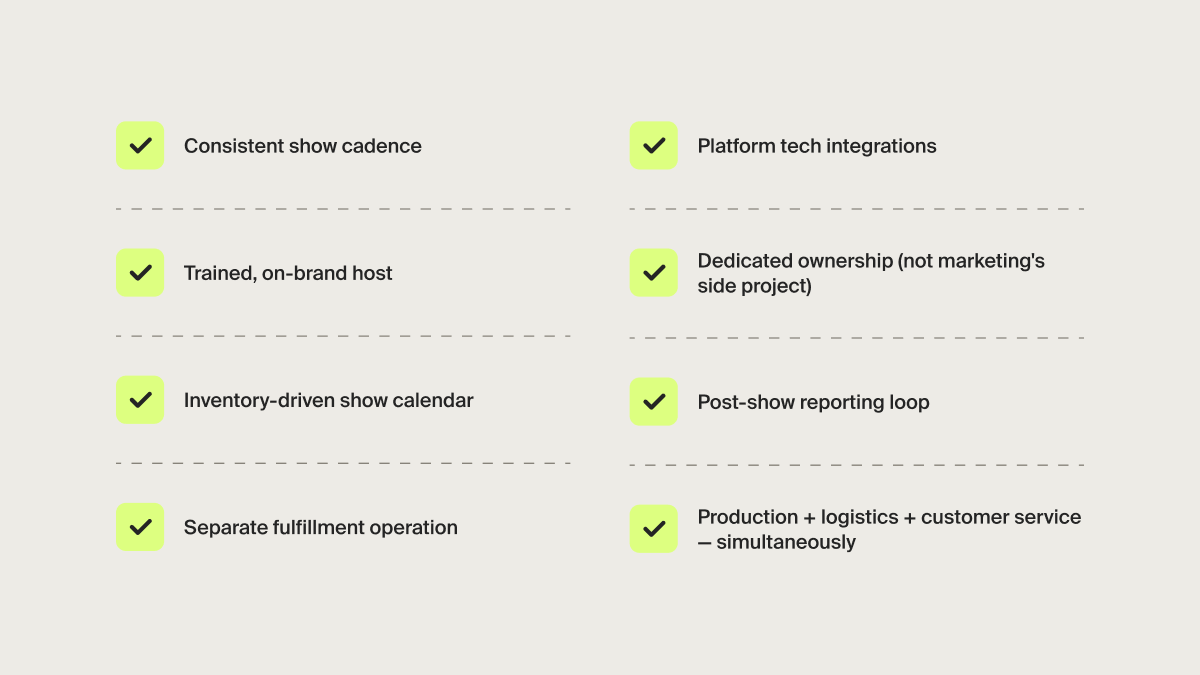
The pattern tends to look like this. Live commerce ownership lands inside brand marketing or social teams, people who are skilled at storytelling and community building but who are not set up to run what is essentially a production studio, a logistics operation, and a customer service function simultaneously. Brands try to build it themselves, find the execution unsustainable at any real frequency, and end up capping shows at once a month or less. That is not a live commerce strategy. It is a live commerce experiment.
Conversations happening across the industry with brand marketing leaders confirm this consistently. The brands that have attempted to build live commerce internally, whether on their owned sites or on platforms like TikTok Live, frequently cite the same pain points: technology integrations that are harder than expected, curation and hosting demands that pull teams away from their core responsibilities, and a general underestimation of how much infrastructure is required to show up consistently and well.
The brands generating real, repeatable revenue from live commerce are the ones that have taken the operational backbone seriously: dedicated hosts trained on product knowledge, show calendars built around inventory strategy, fulfillment handled separately from the core business, and post-show reporting that informs the next one.
The pattern tends to look like this. Live commerce ownership lands inside brand marketing or social teams, people who are skilled at storytelling and community building but who are not set up to run what is essentially a production studio, a logistics operation, and a customer service function simultaneously. Brands try to build it themselves, find the execution unsustainable at any real frequency, and end up capping shows at once a month or less. That is not a live commerce strategy. It is a live commerce experiment.
Conversations happening across the industry with brand marketing leaders confirm this consistently. The brands that have attempted to build live commerce internally, whether on their owned sites or on platforms like TikTok Live, frequently cite the same pain points: technology integrations that are harder than expected, curation and hosting demands that pull teams away from their core responsibilities, and a general underestimation of how much infrastructure is required to show up consistently and well.
The brands generating real, repeatable revenue from live commerce are the ones that have taken the operational backbone seriously: dedicated hosts trained on product knowledge, show calendars built around inventory strategy, fulfillment handled separately from the core business, and post-show reporting that informs the next one.
What It Means for Inventory Management
One advantage of live commerce for fashion brands is what it does to the age-old problem of excess inventory. End-of-season markdowns, second quality goods, and overstocked styles have traditionally meant steep discounts and margin erosion.
Live commerce changes that math. Instead of training customers to wait for a sale, brands can run dedicated live shows where shoppers bid on that inventory. The competitive bidding dynamic means prices often exceed what a standard clearance strategy would achieve. In one case study, a brand recovered 150% more revenue per unit through live commerce than they would have through a traditional sample sale.
Live commerce changes that math. Instead of training customers to wait for a sale, brands can run dedicated live shows where shoppers bid on that inventory. The competitive bidding dynamic means prices often exceed what a standard clearance strategy would achieve. In one case study, a brand recovered 150% more revenue per unit through live commerce than they would have through a traditional sample sale.
Checklist of hidden challenges with Live Commerce.
Where Revive Comes In
Live commerce is often compared to what ecommerce was to brick-and-mortar retail. That comparison might feel bold, but it is worth sitting with. ECommerce rewired consumer expectations about convenience, speed, and access. Live commerce is doing something similar to expectations around discovery, trust, and engagement.
The brands paying close attention right now are not just experimenting with a new format. They are building the operational muscle, the audience loyalty, and the platform presence that will be hard to replicate once this channel fully matures. The brands that figure out the back end early are the ones that will own the front end later.
Revive was built specifically to solve the operational problem that stops most brands from scaling live commerce. The infrastructure is already in place: branded studios, trained hosts, inventory curation, platform management across Whatnot, eBay Live, Poshmark Live, fulfillment, and post-show reporting. Brands do not need to build any of it internally or pull their marketing teams off their core work to make it happen.
The channel is real. The audience is there. The only question is whether your brand has the operational backbone to show up consistently enough to capture it. Revive does.
The brands paying close attention right now are not just experimenting with a new format. They are building the operational muscle, the audience loyalty, and the platform presence that will be hard to replicate once this channel fully matures. The brands that figure out the back end early are the ones that will own the front end later.
Revive was built specifically to solve the operational problem that stops most brands from scaling live commerce. The infrastructure is already in place: branded studios, trained hosts, inventory curation, platform management across Whatnot, eBay Live, Poshmark Live, fulfillment, and post-show reporting. Brands do not need to build any of it internally or pull their marketing teams off their core work to make it happen.
The channel is real. The audience is there. The only question is whether your brand has the operational backbone to show up consistently enough to capture it. Revive does.